US-RSE April 2026 Newsletter
🤳 Just Hit Me Up On Slack 🤳
Published: Apr 13, 2026 by Tinashe M. Tapera (Author & Editor), Sandra Gesing (Editor), Ian Cosden (Editor)
Welcome to the April 2026 issue of the US Research Software Engineer (US-RSE) newsletter! If you’re reading this, you’re probably connected with US-RSE through Slack, which is our organization’s primary platform for instant messaging. Most people consider Slack a necessary burden of the workplace, having taken the place of phone calls, fax, pagers, and email. But is there more to Slack than annoying notifications? Today we’re going to discuss what Slack is, how it came about, and how US-RSE members use it to connect, grow, and make real, lasting impact beyond just their code editors.
Question: Who do you think is the chattiest Slack user in US-RSE? Place your bets NOW! 😉

In this issue:
- 1 🔔 Just Slack Me, Whenever! 🔔
- 2 📣 Mark Your Calendars for USRSE’26! 📣
- 3 📝 From the Executive Desk… 📝
- 4 🛞 Steering Committee Updates 🛞
- 5 🤝 Organizational Founding Membership 🤝
- 6 🗞️ Community News 🗞️
- 7 👀 Interesting Events and Opportunities 👀
- 8 📚 Featured Reads, Videos, and Podcasts 📚
- 9 🏃 Get Involved! 🏃
- 10 🧑💼 Recent Job Postings 🧑💼
🔔 Just Slack Me, Whenever! 🔔
In 2012, software engineer Stewart Butterfield was hard at work on what he believed to be the next big thing in MMORPGs. The game, called “Glitch,” ended up being a commercial flop, and Butterfield and his team needed to pivot quickly to make the most of the 6 million dollars they had left from investor Ben Horowitz. Instead of throwing in the towel, Butterfield called Horowitz on the phone and proposed a new idea. Throughout the development process, Butterfield told Horowitz, the team of engineers had developed a novel instant messaging system to facilitate commnunication in-game, and in the process of eating their own dog food, discovered that the system worked really well for managing their work communications, too. Butterfield proposed that their company, then called Tiny Speck, pivot to focus on building a new product based on this instant messaging system. The result was the creation of Slack, which has since become one of the most popular communication platforms in the world.
Today, Slack powers communication and collaboration for millions of users and businesses, and has transformed the way teams collaborate and communicate. At US-RSE, we of course use Slack to manage internal communications between leadership teams, but more importantly, it has grown to become the virtual landing page for our community. At present, there are over 140 individual channels dating back to 2018, with over 3100 unique member accounts participating in the conversation. Some days see over 500 messages going back and forth between members and channels:

One unique feature of Slack is the ability to create channels, which act
as virtual rooms dedicated to specific topics, projects, or interests.
These channels can be private or public, allowing teams to organize
conversations by priority, relevance, and interest. At US-RSE, we also
have meta-grouping channels, such as “Working Groups,” (#wg-) and
“Regional Groups,” (#rg-), which serve as hubs for specific
communities within our larger organization. For example, the
#wg-code-review and wg-diversity-equity-inclusion channels are
spaces for members to discuss and collaborate on code review practices
and DEI initiatives, respectively. The #rg-nyc channel serves as a hub
for members located in and around the greater New York City area, where
they plan get-togethers and other in-person events. Participating in
public channels is a great way to stay informed about what’s going on in
the community, and importantly, it allows everyone in the Slack channel
to follow the conversation and chime in when they have something to
contribute. This helps us all, “learn with the garage door
open,”
increasing the accessibility of our conversations and the impact of our
work.

It may be obvious that the #general channel has the most messages, but
did you know that in a one-year span, some of the most active channels
include #random, #events, and #wg-ux? The most popular
language-specific channel in the Slack was, of course, #python, and
the most active regional group channel was #rg-north-carolina.

And while we as RSEs may still be evaluating AI for its usefulness in our work, Slack’s built-in AI summarization tool tells us that there are a wide array of conversations happening in our Slack, from conference planning, to project management, to hiring and funding announcements.

If you haven’t already, we encourage you to join our Slack and get involved in the conversation. It’s a great way to stay informed about what’s going on in the community, connect with other members, and contribute to the ongoing work of US-RSE. You can get onto our Slack by joining US-RSE free, here.
PS: Just for fun, here’s a table of the top 9 chatty RSEs in our Slack:

See you on Slack!
📣 Mark Your Calendars for USRSE’26! 📣
Save the date for USRSE’26: Advancing Science in the Age of AI
We’re thrilled to announce that USRSE’26 will be held at the San Jose Marriott from October 19-21, 2026 in San Jose, California, with the theme “Advancing Science in the Age of AI”.
General chairs have been appointed to lead each of the core committees for USRSE’26. These chairs have begun assembling sub‑teams from the pool of volunteers who expressed interest in supporting the respective areas. If you were not selected for a chair position, please stay tuned, as chairs reach out for volunteers for these committee positions.
What’s next?
- Call for Proposals: Submit your work via papers, short talks, BoFs, workshops, or posters. View More
- Call for Reviewers: Play a key role in creating a dynamic and varied technical program that will appeal to conference attendees from all RSE backgrounds. Apply to Review
- Committee Formation: Sub‑teams will be formed shortly; be on the lookout for an email from a perspective committee chair with details.
- Stay Informed: Regular updates will be posted at us-rse.org/usrse26. Please bookmark the page and check back frequently for the latest information.
Your continued involvement is essential to the success of USRSE’26. We look forward to collaborating with you to deliver a vibrant, inclusive, and impactful conference.
📧 Join Our Mailing List 📧
Want to stay updated on all things US-RSE? Join our mailing list to receive direct news about all US-RSE conferences. Sign up here.
💬 Have Questions? 💬
If you have any questions, feel free to reach out to the organizers at usrse26-conference@us-rse.org.
📅 Save the Date 📅
More details about the conference program, registration, and travel information will be coming your way in the months ahead. Stay tuned at us-rse.org/usrse26!
We’re looking forward to seeing you all in San Jose!
📝 From the Executive Desk… 📝
In March, I attended Capitol Hill coffee hours with Senator Dick Durbin and Senator Tammy Duckworth, where I had the opportunity to introduce the mission and growing impact of the US Research Software Engineer (US-RSE) Association and take an important step toward raising awareness of the critical role of research software in advancing U.S. science. In addition, I met with staff from Senator Alex Padilla for an in-depth discussion; they expressed strong interest and requested follow-up materials — both quantitative and qualitative data and insights — to better understand the needs and contributions of the RSE community. While these meetings may appear inconsequential, they’re seedlings for longer-term engagement between the RSE community and key stakeholders in Washington, DC, and we are encouraged by the fact that our message is starting to reach key audiences in government.


🛞 Steering Committee Updates 🛞
It’s been a while since you’ve heard from us in the newsletter, but the Steering Committee has been hard at work! Together with our Executive Director, we’ve have done considerable work to support planning of the USRSE’26 conference, including confirming the selection of a venue and reviewing preliminary cost estimations. We’ve also already started looking ahead to USRSE’27 and beyond. We’re developing a conference hosting application process to identify potential future conference locations and chairs farther in advance—more on that in coming months. Additionally, we discussed our policies on issuing statements related to government actions and current events, as well as on the use of AI notetakers during our virtual events, which culminated in an official recommendation delivered to the Code of Conduct Committee on the latter.
Following the cancellation of our planned January retreat due to a combination of weather and illness, the US-RSE Leadership team held two half-day virtual planning sessions in February, focused on increasing the sustainability of our annual conference and updating our governance model to reflect the growing size and responsibilities of our organization. We’re following this up with an in-person working session at the end of this month, where we’ll meet for two days in Chicago with the Executive Director in a concentrated effort to finalize our recommendations for governance model updates.

🤝 Organizational Founding Membership 🤝
US-RSE envisions a future where Research Software Engineers are universally respected for advancing science, technology, and society through the transformative power of research software engineering. We’re excited to share that the momentum around our Organizational Founding Membership continues to grow! See the list below for the current members (six more are onboarding at the moment).
Organizations that join on or before June 30, 2026, will be recognized in perpetuity as founding members. Founding organizations will also lock in current membership fees through December 31, 2028. Organizational support helps sustain and expand vital community offerings, including the annual conference, monthly calls and newsletter, job board, working groups, and new resources.
Please reach out to Sandra Gesing at sandra@us-rse.org if you are interested in becoming an organizational founding member!
Premier Members
Standard Members
Basic Members
🗞️ Community News 🗞️
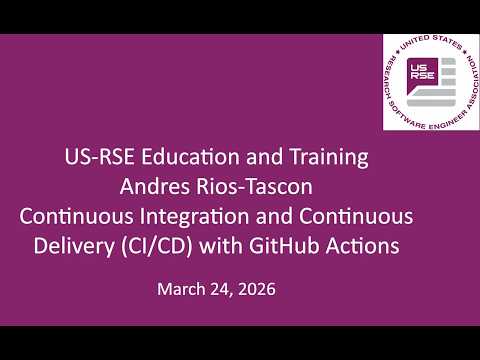
The US-RSE community is full of talented, brilliant people doing amazing work, and every so often, we capture the interactions and collaborations that make our community special on video! Here’s a YouTube video of a recent Education & Training Working Group meeting, where Andres Rios-Tascon presented his tutorial on Continuous Integration and Continuous Delivery (CI/CD) with GitHub Actions.
Did you know that we have a community Code of Conduct? Anyone is able to view it in the
#code_of_conductSlack channel, underFiles!
Community Calls
On March 12th, the US-RSE community got together to discuss Legacy Code: Horrors and Successes!
We heard stories from Keith, James, Brad, and more about some of the projects they’ve inherited and how they dealt with codebases with developers in absentia, cryptic comments and functions, and the different edge cases that can come up when handling them.
Our next meeting is scheduled for Thursday, May 14, 2026, 12:00PM EST. We hope to see you there!
👀 Interesting Events and Opportunities 👀
🚀 HICSS 2027 Call for Participation: Minitracks relevant to RSEs🤩
The Hawaii International Conference on System Sciences (HICSS) invites submission of papers to its 60th annual conference, HICSS 2027, which will be held January 5-8, 2027 in Hawaii. HICSS solicits papers that emphasize advances in research and development in several areas of system sciences. As a premier interdisciplinary conference covering a wide range of topics in information systems and technology, two Minitracks at the conference appear particularly relevant to research software engineers (RSEs):
- AI’s impact on Software Engineering
- Sustainable Software: Usable, Maintainable, and Reproducible
Learn more at the HICSS website, and if you have any other questions, feel free to reach out to Sandra on Slack or via email
🚀 Supercomputing and the Future of AI: Watch the Full Virtual Exchange Series On-Demand! 🤖
Our exciting webinar series for K–12 classrooms, presented in partnership with Reach the World, has officially wrapped! Over the past ten weeks, more than 840 students joined us to explore the fascinating world of supercomputing, quantum computing, and artificial intelligence.
Now, all episodes are available to watch on-demand along with companion journal articles that bring the topics to life for students, educators, and curious minds of all ages. Together with Reach the World, US-RSE created this virtual exchange to offer a behind-the-scenes look at how research software engineers and data scientists use cutting-edge computing to tackle real-world challenges.
Learn more at ReachTheWorld.org, and please reach out to Sandra Gesing with any questions
🚀 Contribute to the future of DEI in US-RSE
The US-RSE DEI Working Group is seeking input from the community! We’re exploring new ways to foster diversity, equity, and inclusion within our organization and would love to hear your ideas. What would make US-RSE a more inclusive and welcoming space for you and others?
Let’s work together to make US-RSE a place where everyone feels they belong.
If you have suggestions, big or small, please share them in the #dei-discussion Slack channel or reach out directly to the DEI Working Group. Your feedback will help guide our future initiatives and ensure they reflect the needs of our diverse community.
🚀 Simulation Software Engineering Training
In case you happen to be teaching simulation software and related RSE topics, The SSE lecture series from the University of Stuttgart is available for free!
In this series, you will get full access to materials for teaching the software tools used to ensure good software engineering for open-source simulation software such as FEniCS, PETSc, TRILINOS, DuMuX, preCICE, or SU2. This is not a course focused on programming and programming paradigms, but on the techniques and the corresponding tools.
Check out the course homepage here!
🚀 Mentor a Hackathon at Open Hackathons 2026!
Open Hackathon is inviting you to consider serving as a mentor for the upcoming NCAR / NLR / NOAA Open Hackathon scheduled May 5-7th (with virtual engagements meeting teams two weeks leading up to the hybrid event). The hackathon will be hosted at NCAR’s Mesa Laboratory in Boulder, CO. We are also planning to offer travel support for mentors to participate in person if they’d like and would benefit being with hackathon teams physically. A variety of projects will be part of the event, from optimizing/porting Fortran GPU code to Python TF/PyTorch. Some specific libraries or codebases to be used by teams include BerkeleyGW, MPAS, CTSM, AMReX, and Scalapack among others. There’s even one team planning to use Qiskit (if you know any quantum focused software engineers, please reach out).
If you have any interest in supporting this event, please reach out to dhoward@ucar.edu or forward this message to relevant colleagues. If you are already excited to become a mentor, you can directly apply at https://www.openhackathons.org/s/mentor (just mention NNN Hack). Early career or junior mentors are also welcome as we typically pair new mentors with experienced ones as appropriate. You can also engage with the mentor community towards supporting future Open Hackathon events, including NERSC’s and others later this year. See all upcoming events here.
🚀 📣 Call for Papers – SP4Sci’26 Workshop on Scalable, Portable & Productive Scientific Computing
We would like to bring to your attention the SP4Sci’26 Workshop on Scalable, Portable and Productive Scientific Computing, which will be held in conjunction with ACM Computing Frontiers 2026 (Catania, Italy, May 19-21, 2026).
The workshop focuses on programming models, tools, runtime systems, and application experiences that enable scientific software to achieve performance, portability, and long-term maintainability across increasingly heterogeneous computing platforms.
We would appreciate your consideration in submitting a paper to the workshop. We welcome contributions covering (but not limited to):
- Performance-portable programming models and compilers
- Abstractions, DSLs, and frameworks for scientific applications
- Strategies for porting legacy codes to heterogeneous architectures
- Runtime systems and co-design approaches
- Case studies and experience reports from real scientific workloads
Full details, including topics of interest and submission instructions, are available on the workshop website.
🚀 ANNOUNCING THE OSG SCHOOL 2026! 🎓
Could you transform your research with extra computing capacity beyond your laptop or lab computers? Do you need help managing your research computing workloads with automation? If you run or support research workloads that can be described by lists of independent computing tasks, we can help! For example: https://osg-htc.org/services/open_science_pool.html
We are seeking applicants for the OSG School 2026, to be held July 13-17 at the beautiful University of Wisconsin-Madison. Apply by March 20!
The OSG School teaches you how to use high-throughput computing effectively and get a research workload up and running. We use lectures, demos, hands- on exercises, personal consulting with OSG experts, and even roleplaying.
Past participants have come from physics, chemistry, engineering, math, bio and life sciences, earth sciences, agricultural and animal sciences, social sciences, economics, medicine, and more.
Ideal candidates are:
-
Researchers (especially graduate students and post-docs) for whom large- scale computing is a key part of the research process;
-
Research support staff who work with current or potential users of high throughput computing;
-
Instructors (at the post-secondary level) who are ready to integrate high throughput computing into their research based curriculum.
We aim to pay all base travel, hotel, and food costs for applicants whom we invite to attend.
This is an in-person event, and we strive to provide a healthy environment for all.
Learn more at: OSG School 2026 and apply by March 20, 2026!
📢 2026 DASH / IHDEA Meeting
📅 When: October 5-9, 2026
📍 Where: Dublin, Ireland, and virtual
Save the date! 📅
The 2026 DASH / IHDEA Meeting will take place 5-9 October 2026, hosted by the Dublin Institute for Advanced Studies (DIAS) in Dublin, Ireland, with virtual participation supported. 🥳
The DASH (Data Analysis and Software in Heliophysics) and IHDEA (International Heliophysics Data Environment Alliance) meetings bring together scientists and software developers working on data analysis, algorithms, community software, data systems, and standards across heliophysics - from the Sun to geospace and beyond. We invite the full solar and heliophysics data, software, and science community to join us. More details coming soon, including a call for session proposals.
For more information, visit: dash.heliophysics.net and ihdea.net.
📢 US-RSE Chicago Regional Meetup!🍃
📅 When: April 23, 2026, 5:30 PM - 7:00 PM CDT
📍 Where: Loyola University, Chicago, IL
Join us for the first Chicago Research Software Engineers (RSE) Meetup! This kickoff event is a casual, social gathering designed to bring together people across the Chicago area who are interested in the intersection of software and research. We’ll have pizza, light icebreakers, and plenty of time to meet others from universities, labs, and industry. We’ll also include a few short, informal talks introducing the RSE community, what the role looks like in practice, and how you can get involved locally and nationally. Whether you identify as an RSE, write code for research, are curious about the field, or just want to meet others working in similar spaces, this is a great place to start. Come hang out, meet the community, and help shape the future of RSE in Chicago.
The event is being organized via Meetup.com, so please RSVP there if you plan to attend: Chicago RSE Meetup
Have an event or opportunity you want to promote? Reach out on Slack in
the #newsletters channel!
📚 Featured Reads, Videos, and Podcasts 📚
📑 Recent Publications
-
Chen, E. (2026). AI is threatening science jobs. Which ones are most at risk?, Nature 651(8104). Read the Article.
-
Chugunova, M., Harhoff, D., Hölzle, K.et al. (2026). Who uses AI in research, and for what? [Large-scale]{.nocase} survey evidence from Germany, Research Policy 55(2). Read the Article.
📇 Blog Posts, Videos, & Other Reads
-
Besser, S., Jensen, E., Katz, D.. How generative AI is shaping research ... | Open Research Europe, . Check it out.
-
Bort, J. (2026). A VC and some big-name programmers are trying to solve open source’s funding problem, permanently, . Check it out.
-
Claburn, T.. AI still doesn’t work very well in business, reckoning soon, . Check it out.
-
Claburn, T.. GitHub: We going to train on your data after all, . Check it out.
-
Ernst, N., Awon, A., Hingmire, S.et al. (2026). The Nature of Technical Debt in Research Software, . Read the Article.
-
Nesbitt, A. (2026). Guided Meditation for Developers, . Check it out.
-
OpenAI, . (2026). OpenAI to acquire Astral, . Check it out.
-
Stetskov, D. (2025). Claude Code’s Source: 3,167-Line Function, Regex Sentiment, . Check it out.
-
Stetskov, D. (2026). The Great Software Quality Collapse: How We Normalized Catastrophe, . Check it out.
-
Substack, .. Artificial Intelligence can Erase Technical Debt, . Check it out.
Did you read something interesting this week? Want to share your own
publications in the community? Reach out on Slack in the #newsletters
channel!
🏃 Get Involved! 🏃
US-RSE Working Groups:
- Code Review
- Community Calls
- Diversity, Equity, and Inclusion
- Education and Training
- Group Management
- Mentorship Program
- Outreach
- RSE Empowerment in National Labs
- Testing
- User Experience
- Website
🧑💼 Recent Job Postings 🧑💼
-
Software Engineer (Astropy)
📍 Simons Foundation, New York City, NY (in-person)
🗓️ Posted: 2026-04-09 | Expires: 2026-05-22 -
Data Systems Software Engineer
📍 Lawrence Berkeley National Lab, Berkeley, CA
🗓️ Posted: 2026-04-04 | Expires: 2026-05-01 -
Support Scientist
📍 Science & Technology Corp (STC), Greenbelt, MD / remote
🗓️ Posted: 2026-03-25 | Expires: 2026-05-01 -
Senior Research Software Engineer
📍 Harvard University, Cambridge, MA
🗓️ Posted: 2026-03-23 | Expires: 2026-07-31 -
Research Software Engineer
📍 Center for Open Neuroscience, Dartmouth College, Hanover, NH (Hybrid)
🗓️ Posted: 2026-03-23 | Expires: 2026-05-23 -
Systems Software Engineer
📍 Mellon College of Science - Physics Department, Carnegie Mellon University, Pittsburgh, PA
🗓️ Posted: 2026-03-04 | Expires: 2026-05-04 -
Scientific Applications Programmer
📍 Lynker, College Park, MD (remote possible)
🗓️ Posted: 2026-02-11 | Expires: 2026-04-30 -
Open Source Software Technology Program Developer
📍 Kitware, Inc, Clifton Park, NY
🗓️ Posted: 2026-02-09 | Expires: 2026-05-15 -
Senior Software Engineer
📍 Internet2, Remote
🗓️ Posted: 2026-01-28 | Expires: 2026-04-30 -
Research Engineer / Research Scientist
📍 Aeolus Labs, San Francisco, CA
🗓️ Posted: 2025-12-08 | Expires: 2026-04-30
Other Job Boards
- Research Software Engineering Opportunities in other associations/societies
- Software Carpentries Job Opportunities
- Academic Data Science Alliance Jobs
- High Performance Computing (HPC) Jobs from hpc.social
- SGX3 and SGCI Science Gateways Community Jobs Board
You can learn more about job boards in the #jobs Slack channel!
This newsletter is a joint effort of members of the US-RSE Association.
© US-RSE • 2021–2026 • US-RSE is a fiscally sponsored project of Community Initiatives